


News

2026.02.06
When choosing a security camera, specs like focal length, sensor size, and FOV can be confusing. This guide breaks down these terms and shows how they affect actual footage, helping you pick the right lens for your coverage.
Focal Length — Determines Frame Width and Zoom
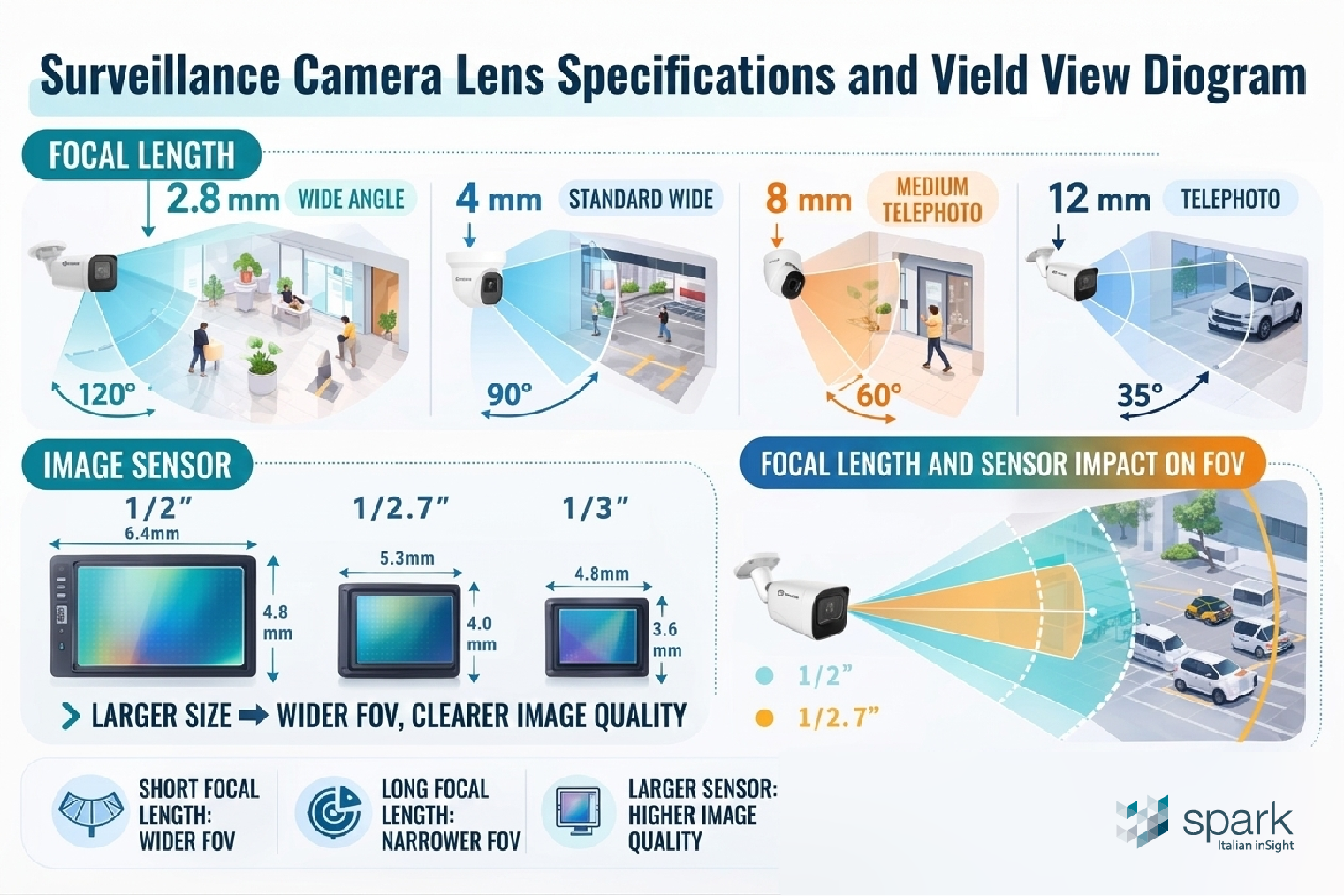
Focal length is the most basic optical parameter of a lens, referring to the distance light travels through the lens to the sensor. It directly affects the width of the image and the zoom effect:
Examples:
-
2.8mm lens → Wide-angle, suitable for offices, malls, or indoor public areas.
-
12mm lens → Telephoto, ideal for entrances, parking lots, or perimeter monitoring.
If unsure, the Omnieye BM (bullet) and DM (dome) zoom cameras support motorized zoom (2.7–13.5mm), allowing flexible adjustments after installation.
When choosing focal length, balance coverage area with image detail to meet surveillance needs.
Sensor Size — Affects Coverage and Image Quality
Sensor size refers to the effective imaging area of the camera sensor, usually measured in inches (e.g., 1/3", 1/2", 1/2.7", 1"). Larger sensors capture more light, producing brighter images with more detail in low-light environments. Smaller sensors have narrower coverage, often requiring shorter focal lengths to achieve the same field of view.
Example: 1/2" sensor effective area:
-
Width: 6.4mm
-
Height: 4.8mm
-
Diagonal: ~8.0mm
Key point: For the same focal length, a larger sensor gives a wider FOV and richer image detail.
Field of View (FOV) — Lens Coverage Area
FOV defines the visible area captured by the camera, typically expressed as:
-
Horizontal FOV: Left-to-right coverage
-
Vertical FOV: Top-to-bottom coverage
-
Diagonal FOV: Corner-to-corner coverage
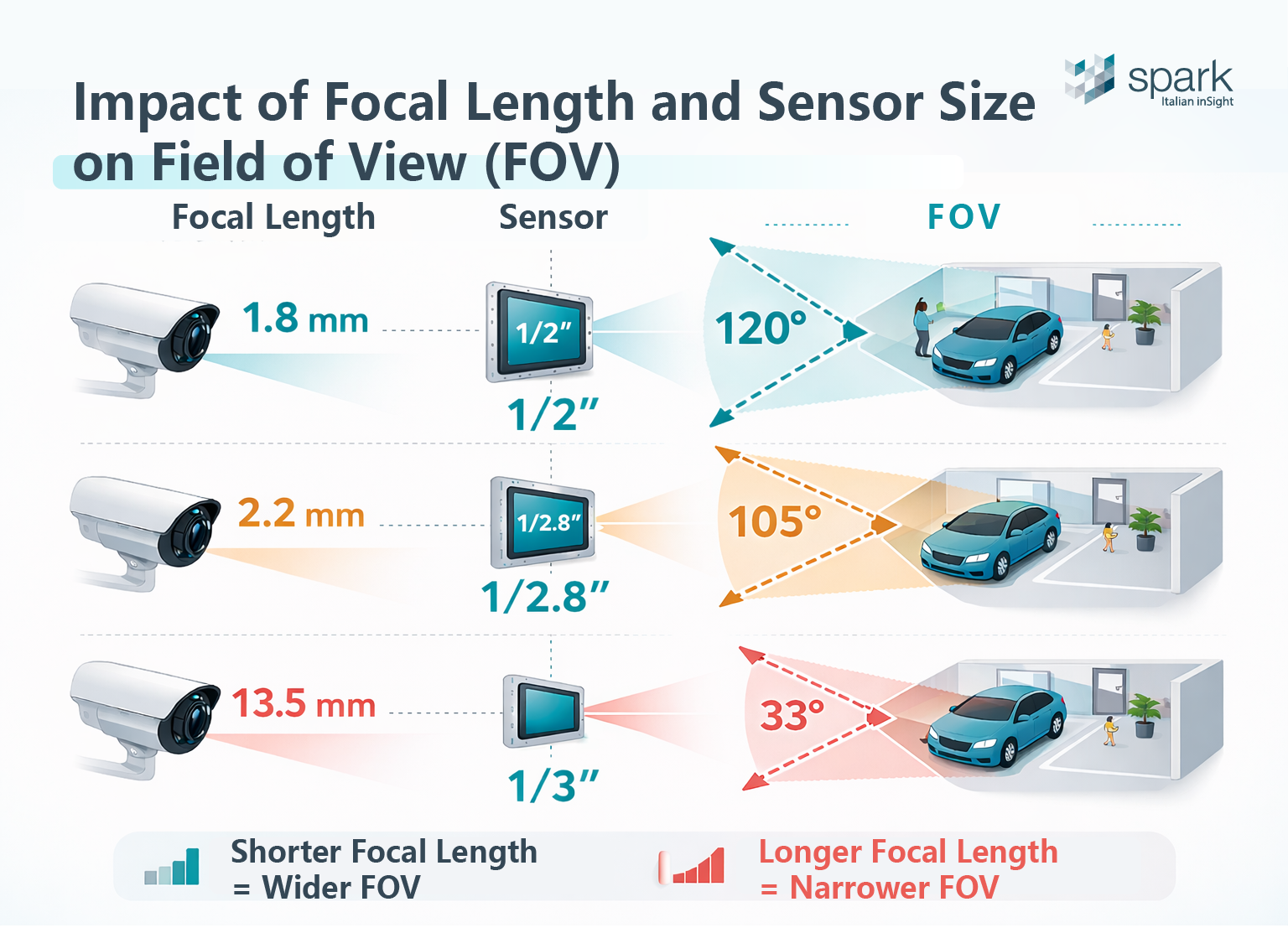
FOV depends on focal length and sensor size:
-
Short focal length + large sensor → Wide FOV, ideal for broad surveillance.
-
Long focal length + small sensor → Narrow FOV, ideal for precise monitoring.
Examples:
-
1.8mm focal length with 1/2" sensor → ~120° horizontal FOV
-
Same focal length with 1/3" sensor → Horizontal FOV shrinks to 80°–30°
Understanding the relationship between FOV and sensor size helps you select the lens that best covers your surveillance area.
Zoom Ratio — Adjustable Magnification
Zoom ratio indicates the lens’s range from wide-angle to telephoto, defining how much the image can be magnified.
Example: 2.8–12mm lens → ~4.3× zoom, meaning the telephoto end magnifies roughly 4× compared to the wide-angle end.
-
High-zoom lenses: Suitable for areas requiring both wide coverage and detailed monitoring, like parking lots or large commercial spaces.
-
Fixed focal lenses: Best for single-view surveillance, with lower cost.
Practical Recommendations
Wide-Area Surveillance:
Use short focal length wide-angle lenses (2.2–4mm) with medium-to-large sensors to cover broad areas—ideal for public spaces, malls, or offices.
Long-Distance Precision Monitoring:
Use long focal length lenses (12mm+) with medium or small sensors to focus on specific targets, such as entrances, parking lots, or perimeter fences.
Situations Requiring Adjustable Zoom:
High zoom lenses (4× or 5×) allow flexibility to adjust FOV and capture both wide areas and detailed targets.
Watch for Distortion:
Wide-angle lenses, especially at edges or panoramic views, may introduce distortion affecting image proportions—plan accordingly to avoid misjudging distances or coverage.
Key Takeaways
-
Focal Length: Determines frame width and magnification.
-
Sensor Size: Affects coverage and image quality for the same focal length.
-
FOV: Shows how much the lens can capture.
-
Distortion: Impacts image proportions and precision.
-
Zoom Ratio: Defines how much the lens can adjust magnification.
By understanding these concepts, you can choose the right lens for indoor, outdoor, wide-area, or precise monitoring—ensuring your security system delivers optimal performance.
When choosing a security camera, specs like focal length, sensor size, and FOV can be confusing. This guide breaks down these terms and shows how they affect actual footage, helping you pick the right lens for your coverage.
Focal Length — Determines Frame Width and Zoom
Focal length is the most basic optical parameter of a lens, referring to the distance light travels through the lens to the sensor. It directly affects the width of the image and the zoom effect:
Examples:
-
2.8mm lens → Wide-angle, suitable for offices, malls, or indoor public areas.
-
12mm lens → Telephoto, ideal for entrances, parking lots, or perimeter monitoring.
If unsure, the Omnieye BM (bullet) and DM (dome) zoom cameras support motorized zoom (2.7–13.5mm), allowing flexible adjustments after installation.
When choosing focal length, balance coverage area with image detail to meet surveillance needs.
Sensor Size — Affects Coverage and Image Quality
Sensor size refers to the effective imaging area of the camera sensor, usually measured in inches (e.g., 1/3", 1/2", 1/2.7", 1"). Larger sensors capture more light, producing brighter images with more detail in low-light environments. Smaller sensors have narrower coverage, often requiring shorter focal lengths to achieve the same field of view.
Example: 1/2" sensor effective area:
-
Width: 6.4mm
-
Height: 4.8mm
-
Diagonal: ~8.0mm
Key point: For the same focal length, a larger sensor gives a wider FOV and richer image detail.
Field of View (FOV) — Lens Coverage Area
FOV defines the visible area captured by the camera, typically expressed as:
-
Horizontal FOV: Left-to-right coverage
-
Vertical FOV: Top-to-bottom coverage
-
Diagonal FOV: Corner-to-corner coverage
FOV depends on focal length and sensor size:
-
Short focal length + large sensor → Wide FOV, ideal for broad surveillance.
-
Long focal length + small sensor → Narrow FOV, ideal for precise monitoring.
Examples:
-
1.8mm focal length with 1/2" sensor → ~120° horizontal FOV
-
Same focal length with 1/3" sensor → Horizontal FOV shrinks to 80°–30°
Understanding the relationship between FOV and sensor size helps you select the lens that best covers your surveillance area.
Zoom Ratio — Adjustable Magnification
Zoom ratio indicates the lens’s range from wide-angle to telephoto, defining how much the image can be magnified.
Example: 2.8–12mm lens → ~4.3× zoom, meaning the telephoto end magnifies roughly 4× compared to the wide-angle end.
-
High-zoom lenses: Suitable for areas requiring both wide coverage and detailed monitoring, like parking lots or large commercial spaces.
-
Fixed focal lenses: Best for single-view surveillance, with lower cost.
Practical Recommendations
Wide-Area Surveillance:
Use short focal length wide-angle lenses (2.2–4mm) with medium-to-large sensors to cover broad areas—ideal for public spaces, malls, or offices.
Long-Distance Precision Monitoring:
Use long focal length lenses (12mm+) with medium or small sensors to focus on specific targets, such as entrances, parking lots, or perimeter fences.
Situations Requiring Adjustable Zoom:
High zoom lenses (4× or 5×) allow flexibility to adjust FOV and capture both wide areas and detailed targets.
Watch for Distortion:
Wide-angle lenses, especially at edges or panoramic views, may introduce distortion affecting image proportions—plan accordingly to avoid misjudging distances or coverage.
Key Takeaways
-
Focal Length: Determines frame width and magnification.
-
Sensor Size: Affects coverage and image quality for the same focal length.
-
FOV: Shows how much the lens can capture.
-
Distortion: Impacts image proportions and precision.
-
Zoom Ratio: Defines how much the lens can adjust magnification.
By understanding these concepts, you can choose the right lens for indoor, outdoor, wide-area, or precise monitoring—ensuring your security system delivers optimal performance.